Microchip Unveils Groundbreaking DC-DC Converter for Space Applications
In the ever-evolving world of satellite technology, Microchip has just unveiled something groundbreaking—the LE50-28 series of radiation-tolerant DC-DC converters. These are specifically crafted for Low Earth Orbit (LEO) satellites, meeting the growing demands of 5G communication, cube satellites, and IoT applications.
Why This Matters
The demand for dependable, reasonably priced, and adaptable space-grade technologies is higher than ever because of the expanding LEO market. In between the more costly radiation-hardened alternatives and non-radiation-tolerant commercial converters, these isolated DC-DC converters provide an affordable alternative. Because of this, they are both reasonably priced and compatible with missions.
What Makes the LE50-28 Series Stand Out?
- Versatility: Available in nine variants, the LE50-28 series provides both single and triple output options, ranging from 3.3V to 28V.
- Compact and Lightweight: The converter weighs just 120 grams, and the EMI filter weighs 82 grams. This makes them easy to integrate into various devices while meeting MIL-STD-461 standards for quick qualification.
- Radiation Tolerance: With a total ionizing dose of up to 50 Krad and latch-up immunity of 37 MeV×cm²/mg, these converters are built to withstand the harsh conditions of LEO applications.
- Efficiency: The LE50-28 series boasts an impressive 80% power conversion efficiency at full load. This reduces the payload size and weight by minimizing energy storage needs.
- High Performance: Supporting up to 50W per unit and up to 200W by paralleling four units, the triple-output version offers three unique outputs in the same footprint, making it incredibly versatile.
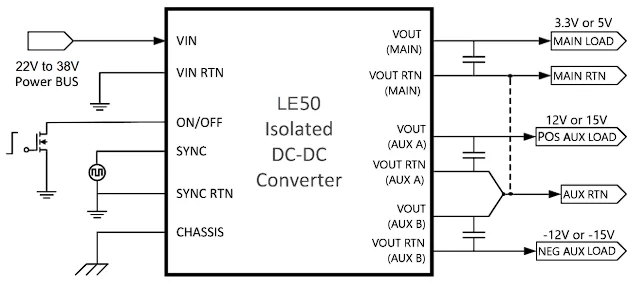
The triple-output LE50-28 is designed to provide multiple outputs
Conclusion
Operating from a 28V bus and featuring an integrated EMI filter to reduce interference, the LE50-28 series is a reliable and efficient solution for satellite applications. With a mean time between failures of one million hours, these converters promise long-term reliability, making them an excellent choice for the next generation of space technology.