Understanding Ohm's Law
Introduction
Ohm’s Law is one of the cornerstones of electrical and electronic engineering. Named after the German physicist Georg Simon Ohm, this law describes the relationship between voltage, current, and resistance in an electrical circuit. Whether you’re a hobbyist tinkering with simple circuits or an engineer working on complex electronic systems, understanding Ohm’s Law is essential.
What is Ohm’s Law?
Ohm’s Law states that the current (I) passing through a conductor between two points is directly proportional to the voltage (V) across the two points and inversely proportional to the resistance (R) between them. The mathematical formula is:
\[ V = I \times R \]
Where:
- V is the voltage measured in volts (V)
- I is the current measured in amperes (A)
- R is the resistance measured in ohms (Ω)
Understanding the Components
Voltage (V): Voltage, also known as electric potential difference, is the force that pushes electric charges through a conductor. It’s akin to the pressure pushing water through a pipe.
Current (I): Current is the flow of electric charge. It’s similar to the rate at which water flows through a pipe. Higher voltage results in a higher current if the resistance remains constant.
Resistance (R): Resistance is the opposition to the flow of current. It’s like the friction water faces as it flows through a pipe. Higher resistance means less current flows for a given voltage.
Practical Application of Ohm’s Law
To see Ohm’s Law in action, let’s consider a simple example. Imagine you have a 9V battery connected to a resistor with a resistance of 3Ω. Using Ohm’s Law, you can calculate the current flowing through the circuit.
\[ I = \frac{V}{R} = \frac{9V}{3Ω} = 3A \]
This means a current of 3 amperes flows through the circuit.
Why Ohm’s Law is Important
Ohm’s Law is crucial for several reasons:
Circuit Design: Engineers use Ohm’s Law to design circuits and select appropriate components. It helps in calculating the required resistance to achieve a desired current or voltage.
Troubleshooting: When diagnosing issues in electrical circuits, Ohm’s Law helps in identifying whether components are functioning correctly or if there’s an unexpected resistance causing problems.
Safety: Understanding the relationship between voltage, current, and resistance ensures that circuits are designed within safe operational limits, preventing overheating and potential hazards.
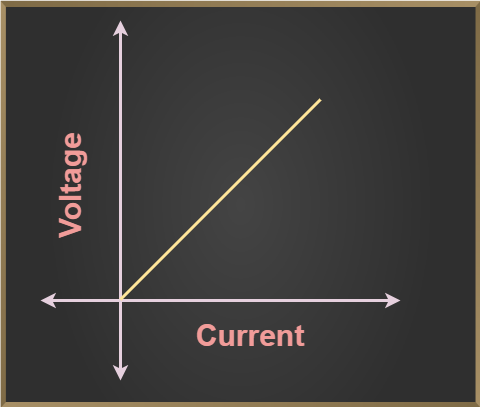
The graph for an ohmic circuit is discussed in the image below,
Ohm’s Law in Series and Parallel Circuits
- Series Circuits: In a series circuit, resistances add up, and the total resistance (R_total) is the sum of all individual resistances. The same current flows through each resistor, but the voltage across each resistor can vary.
\[R_{total} = R_1 + R_2 + R_3 + \ldots \]
- Parallel Circuits: In a parallel circuit, the total resistance is less than the smallest individual resistance. The voltage across each resistor is the same, but the current can vary.
\[ \frac{1}{R_{total}} = \frac{1}{R_1} + \frac{1}{R_2} + \frac{1}{R_3} + \ldots \]
Conclusion
Ohm’s Law is a fundamental principle that provides a simple and powerful tool for understanding and working with electrical circuits. By mastering this law, you can design, analyze, and troubleshoot circuits with confidence. Whether you’re building your first electronic project or working on advanced systems, Ohm’s Law remains an indispensable part of your toolkit.
Video
Here’s a relevant video that explains Ohm’s Law with practical examples and demonstrations.
Stay tuned for more insights into the fascinating world of electronics. Don’t forget to subscribe for updates and follow us on social media!